
If you run a commercial general contractor firm, you are probably leaving up to $500,000 of margin on every single tenant buildout you run — and you do not even know it is gone, because it disappears one $4,000 change order at a time.
In the latest Indiana Drones episode, I walk an active commercial floor in a multi-tenant tower and show you the exact 20-minute workflow that closes that leak. One operator, one handheld scanner, one shareable link, no specialist VDC team required.
This post is the copy-paste deployment guide for that workflow. Read it, send it to your project engineers, send it to your subs. Then go capture your next floor before the drywall closes it up forever.
Watch the Full Walkthrough
The $88 Billion Problem Hiding Behind Every Tenant Buildout
Picture this: a commercial floor in an active multi-tenant tower. Every other floor in the building is already leased, built out, occupied, and generating rent. Your floor is about to go out for bid for a tenant buildout. And right now — at this exact moment — every duct, every conduit, every sprinkler branch, every slab penetration above you is about to disappear forever behind drywall and a ceiling grid.
What happens in the next 30 days determines whether this build comes in on budget or 12% over.
Here is what the industry data says about that 12%:
| Source | Metric | Cost |
|---|---|---|
| Construction Industry Institute | Total rework | 5–12% of total project cost |
| Autodesk | MEP coordination rework alone | 4–6% of project value |
| Industry-wide annual rework | All causes, globally | $88 billion per year |
On a $1M tenant buildout, that is up to $120,000 of your profit margin at risk. On a $5M project, that is up to $500,000 gone. Multiply that across your annual portfolio and you start to see why $88 billion a year is honestly a conservative number.
Almost all of it traces back to one gap: the difference between what the drawings show and what the real-world concrete actually looks like.
That is the gap we are closing in 3D — in 20 minutes — for the price of one bad change order.
Why the Traditional Bid Workflow Bleeds Margin
Here is the workflow most commercial GCs are still running. The GC drafts the scope. The bid package goes out to 15–20 trades. Every one of them needs to physically see this floor to price it accurately.
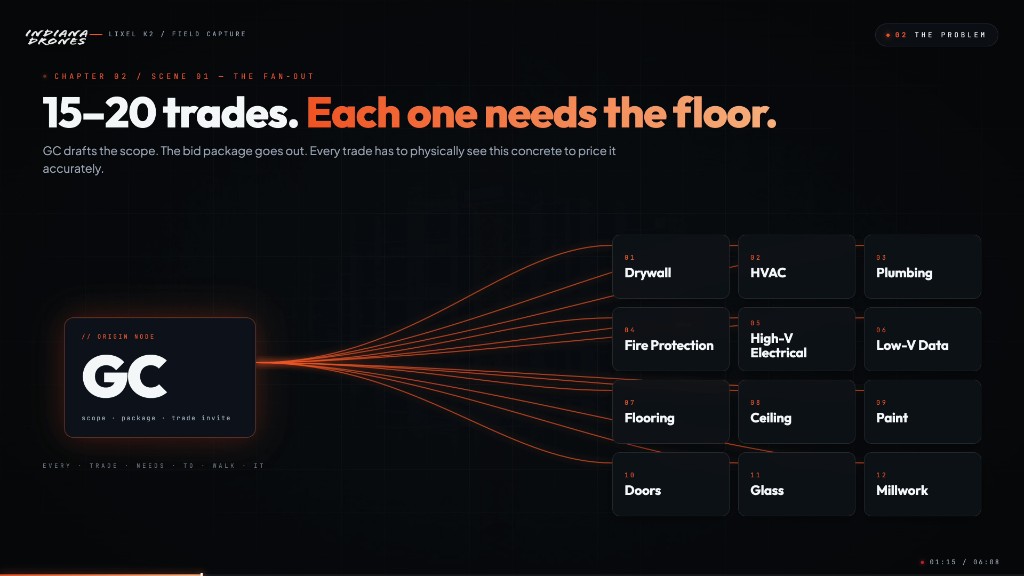 Every trade has to physically walk the floor to bid it. That is up to 20 separate site visits before a single line item is priced.
Site Visits Are a Tax — Not a Calendar Problem
On an active building site, access is not a scheduling exercise. It is an operations problem, and it has a real dollar cost before any work happens:
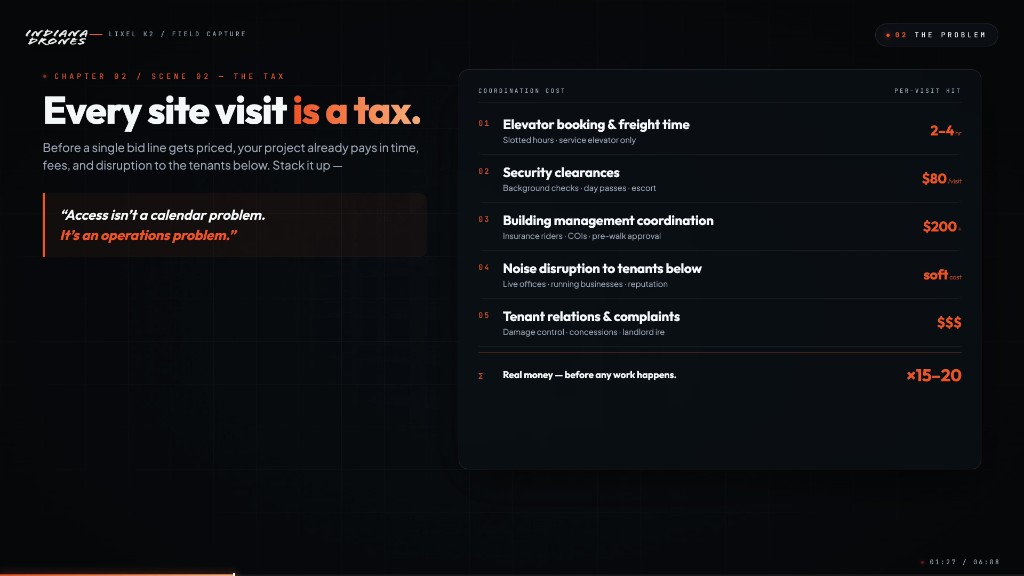 Every site visit costs real money in freight elevator time, security clearances, building management fees, and tenant relations — before a single trade has bid the work.
| Coordination cost | Per-visit hit |
|---|---|
| Freight elevator booking & service-elevator time | 2–4 hours |
| Security clearances, day passes, escorts | $80+ |
| Building management coordination, COIs, pre-walk approval | $200+ |
| Noise disruption to live offices below | Soft cost / reputation |
| Tenant relations & complaints | Damage control + landlord ire |
"Access isn't a calendar problem. It's an operations problem."
Now multiply every one of those line items by 15–20 trades. That is real money — and it is the friendly part of the bid cycle.
The Real Threat: Bid Blind Off 2D Drawings
The coordination tax is annoying. It is not what kills your margin. The real damage hits when a sub cannot make the walk and bids blind off 2D drawings. When that happens, the sub does one of two things:
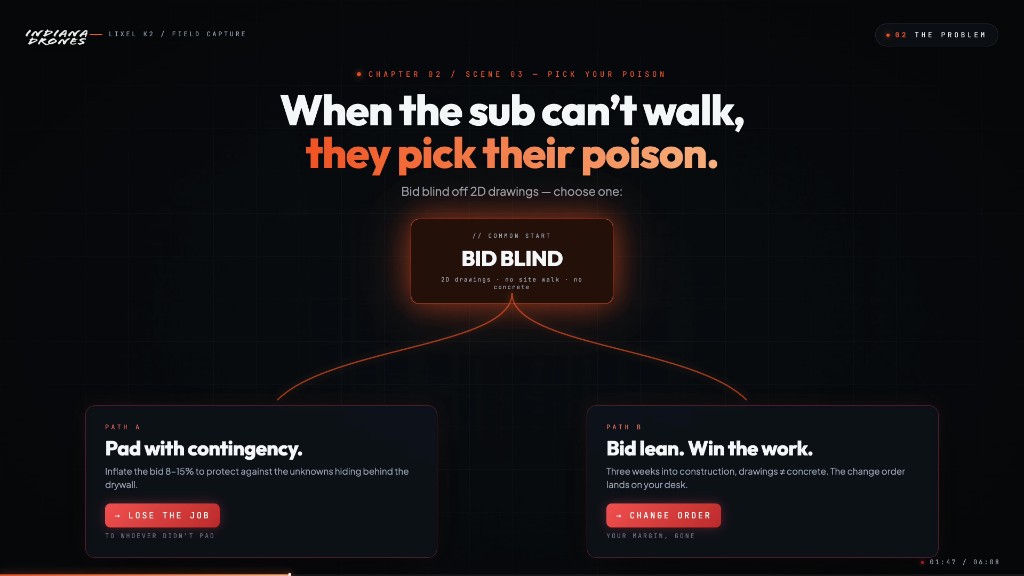 When a sub can't walk the site, they pick their poison: pad the bid 8–15% and lose to whoever didn't, or bid lean and hit you with a change order three weeks into construction.
- Path A — Pad with contingency. Inflate the bid 8–15% to cover the unknowns hiding behind the drywall. Lose the job to whoever didn't pad.
- Path B — Bid lean. Win the work. Three weeks into construction, drawings ≠ concrete. The change order lands on your desk. Your margin, gone.
Either way, you lose. The GC loses a competitive bid, or the GC eats the change order. Both flow back to the same source: the bid was priced against a drawing, not the real world.
 Stack the coordination tax across every trade and you're paying real money before the work even starts. Then layer rework on top.
This is the same playbook Skender, the 70-year-old Chicago GC, deployed across their commercial portfolio to tighten bids, eliminate rework, and resolve field disputes 40% faster than the firms they're competing against. Their VDC team broke the math down on a recent Xgrids webinar — and the punchline is the same: capture once, share with everyone, stop bidding blind.
The Fix: A 20-Minute Walk With the XGRIDS Lixel K2
This is the hardware that closes the gap.
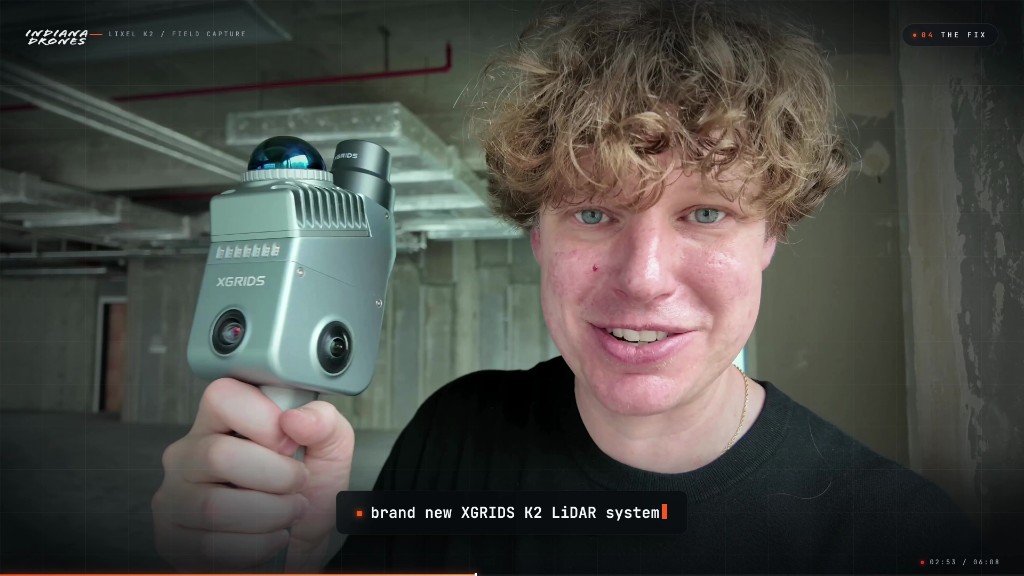 The XGRIDS Lixel K2 — a handheld SLAM scanner that captures both a survey-grade point cloud and a photorealistic 3D Gaussian splat from a single 20-minute walk.
The XGRIDS Lixel K2 is a handheld SLAM-based spatial scanner built for exactly this kind of work. The numbers that matter:
| Spec | Value | Why it matters for a tenant buildout |
|---|---|---|
| Relative accuracy | Sub-1 cm | Measure penetrations, beam depths, conduit spacing right in the data |
| Absolute accuracy | 3 cm | Tie into building grids and BIM models without manual control |
| Built-in RTK | Real-world geo-referencing | One-button alignment to project coordinates |
| Operator setup | No tripod, no targets, no station setup | A project engineer can run it on day one |
| Outputs from a single walk | Colorized engineering point cloud + photorealistic 3D Gaussian splat | The same dataset works for measurement and visualization |
| Capture time | ~20 minutes per floor | Capture during a single tenant access window |
That last row is the whole game. One walk, one operator. From a single capture session you get:
- An engineering-grade point cloud — every duct, sprinkler head, conduit run, and slab penetration measurable to sub-centimeter.
- A photorealistic 3D Gaussian splat — a walkable, "you are standing there" version of the room that anyone can navigate from a browser.
No specialist VDC required. No expensive Faro tripod schedule. Your existing project engineer can do it on day one.
Where the Data Lives: Splat Labs Cloud
Capturing the data is half the job. The other half is putting it in front of every single trade that needs to bid against it — without forcing them to install a 12 GB desktop point-cloud viewer.
That is exactly what Splat Labs does. Upload the Lixel K2 dataset once. You get one viewer that hosts both the LiDAR data and the 3D Gaussian splat side by side, in the browser, on any device, with one shareable link.
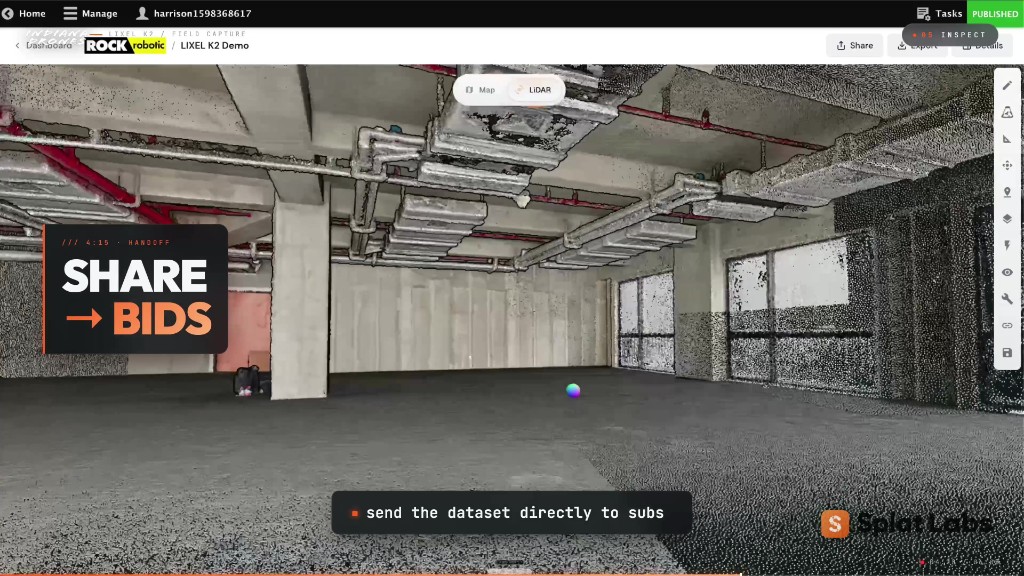 One shareable link replaces 20 site walks. Every subcontractor measures, navigates, and bids off the exact same dataset.
Try the Actual K2 Dataset Yourself
This is the live capture from the floor in the video — Lixel K2, hosted on Splat Labs, no install. Drag to pan, scroll to zoom, switch between LiDAR and the photorealistic splat view:
Every subcontractor on your bid list can do exactly what you just did. From their desk. While the floor is locked. While the freight elevator is booked for someone else. While the tenant below is on a sales call.
This is the link replacing all 20 site visits.
The Copy-Paste Workflow: Deploy This On Your Next Tenant Buildout
Here is the entire workflow as a checklist you can hand to a project engineer this week.
Phase 1 — Capture (Day 0, ~30 minutes total on site)
- Schedule one access window with building management. You only need it once.
- Walk the floor with the Lixel K2. Hold it at chest height, walk at a normal pace, cover every room and adjacent space. Plan ~20 minutes per ~10,000 sq ft of typical commercial floor.
- Capture overhead. Tilt the K2 up at every duct main, sprinkler branch, junction box, and slab penetration. These are the items that will disappear behind ceiling grid.
- Hit every shaft and adjacent room. Mechanical closets, telecom rooms, restroom rough-ins, exterior wall cavities — anywhere a trade will need a number.
Phase 2 — Process and Upload (Day 0, ~1 hour)
- Pull the dataset off the K2 and run the standard processing pipeline. You will get both a colorized point cloud and a 3D Gaussian splat from the same capture.
- Upload to Splat Labs. Project-based pricing, so cost is predictable per buildout. Upload formats:
.PLY,.SPLAT,.KSPLAT,.XGRIDS. - Set sharing permissions. Generate a single read-only link that lets subs view, navigate, and measure without an account.
Phase 3 — Bid Distribution (Day 1)
Send the link with the bid package to every trade. Replace your "site walk window" calendar invite with this email:
Subject: [Project Name] — Tenant Buildout Bid Package + 3D Site Capture
Hi [Sub PM],
Bid package for [Project Name] is attached. Bids due [date].
Instead of a site walk window, we captured the floor in 3D last [day]. You can walk the entire space, take measurements, and inspect every overhead system from your desk:
3D site capture: [Splat Labs link]
Both the LiDAR point cloud and the photorealistic view are in one viewer. Toggle between them with the button in the top toolbar. Click any two points to measure.
If your team still wants to walk it, let me know and we'll coordinate a single window — but the data should give you everything you need to bid tight and bid accurate.
Thanks, [PM Name]
Phase 4 — Bid Review and Award (Days 7–14)
When bids come back, open every bid alongside the Splat Labs viewer. If a sub has padded a number, walk the area in the splat. If something looks wrong in the drawings, measure it directly in the LiDAR data. Your conversations with subs become "look at this exact location" instead of "we'll have to verify."
Phase 5 — Construction and Disputes (Ongoing)
Keep the capture link in the project record. When a trade hits an unexpected condition three weeks in, you have a timestamped 3D record of the existing conditions on bid day. Disputes that used to take 30 days of email and finger-pointing get resolved in one Splat Labs link.
This is where Skender's VDC team reports resolving field disputes 40% faster than competing firms — the data was already there, captured, shared, and unambiguous.
The ROI Math, One More Time
Run the math on your own portfolio:
| Project size | Rework at risk (5–12%) | One bad change order |
|---|---|---|
| $1M tenant buildout | $50,000 – $120,000 | Often the entire margin |
| $5M tenant buildout | $250,000 – $600,000 | Half a million in a single change |
| $20M portfolio of buildouts | $1M – $2.4M annually | Quietly disappearing |
A Lixel K2 plus a Splat Labs project plan costs a small fraction of even one of those rework events. If the workflow works one time in a year — one change order avoided, one bid padded $20K less, one dispute resolved without litigation — the hardware and the software have paid for themselves and the entire year of service.
This is not a "nice-to-have for the VDC team." This is risk insurance with a payback period of weeks.
Who Should Be Running This Workflow Right Now
If you are a commercial GC: Your project engineers should be capturing every tenant buildout floor before the ceiling closes. If you are not, your competitors who are will out-bid you on contingency and out-execute you on change orders.
If you are a reality-capture service provider: This video, this post, and this ROI math are the exact pitch to take to your local commercial GCs. Walk in with the Lixel K2, scan their next floor for free as a demo, host it on Splat Labs, hand them the link. Watch the bid cycle compress in front of them.
If you are a subcontractor: The first GC in your market to send you one of these links instead of a site-walk invite is going to win your most accurate bids. Be ready.
Get the Hardware, the Software, and the Workflow
You can buy the Lixel K2 directly from Splat Labs and get a free 1-year Splat Labs Starter Plan with it. That is the host-and-share layer that turns your scan into a bid-cycle weapon. (Buying direct from Xgrids does not include the platform.)
Already have a scanner? Splat Labs accepts splats and point clouds from any source — PortalCam, Lixel L2 Pro, Lixel K2, Postshot, Luma, Kiri Engine. Upload .PLY, .SPLAT, .KSPLAT, or .XGRIDS files and start sharing.
Keep Going
If you want to keep stacking margin back into your projects, here is what to read and watch next:
- Walk the live K2 dataset from this video: Lixel K2 demo capture on Splat Labs
- Deeper case study: How Skender uses Gaussian Splatting to tighten bids and resolve disputes 40% faster
- Companion read: Walk Your Building Before It Exists — combining capture, AI, and 3D objects on the same site
- Subscribe to Indiana Drones on YouTube for more field-tested 3D capture workflows.
I make these videos because I want to help GCs make money and save money. The math here is honest, the workflow is real, and the technology is finally simple enough that your existing team can run it.
Now go capture your next floor before the drywall closes it up forever.
— Indiana Drones
Disclaimer: Specifications and pricing are subject to change. Visit splatlabs.ai for the most up-to-date Lixel K2 availability and Splat Labs plan information. The 5–12% rework figure is from the Construction Industry Institute; the 4–6% MEP coordination rework figure is from Autodesk; the $88B global rework figure is industry-wide and not specific to any single project or firm.