
If you are running a modern Virtual Design and Construction (VDC) team, you are likely already using reality capture. But you are also likely dealing with the frustrations that come with it.
If you send a point cloud to a project owner or architect, they will not know how to look at it — it is visually messy and requires specialized software. If you send them a folder of 360° photos, they can only jump from waypoint to waypoint, losing the true spatial context of the site.
So, do you need Gaussian Splatting?
If you want to tighten subcontractor bids, mitigate the risk of costly rework, and allow anyone on your team to capture a site in minutes, the answer is a resounding yes.
In a recent webinar hosted by Xgrids on LinkedIn, Ben Stocker, Senior Construction Technologist at Skender — a premier commercial contractor in Chicago with over 70 years in the industry — broke down exactly why his VDC team relies on Gaussian Splats to document their massive projects. Here is why top AEC firms are adding Gaussian Splatting to their workflows, and what it can do for your ROI.
1. You Need to Streamline Subcontractor Bidding
Before a project even breaks ground, the bidding process sets the financial tone. Traditionally, this requires a mandatory "site walk" where dozens of subcontractors converge on the property, frantically snapping photos and scribbling notes to formulate their bids. It is inefficient, and missing a detail during that walk leads to inflated bids filled with contingencies.
Skender completely changed this workflow using Gaussian Splats. By doing a quick walkthrough with a handheld spatial scanner, they capture the existing conditions of the entire site in minutes — then share the photorealistic 3D model directly with every bidding subcontractor.
"We can share this out with all of our bidding subcontractors... Usually, there's a site walk where everyone has to go around and document what they can and then make their bids off that. But if we share this with everyone, they can more accurately create those bids for us."
— Ben Stocker, Senior Construction Technologist, Skender
The Splat Labs Advantage
You cannot ask 20 different subcontractors to download special 3D software just to bid on your project. With the Splat Labs Cloud, you do not have to. You simply generate a secure link and email it to your bidders. They can "walk" the photorealistic 3D space, look at the ceiling, inspect the floors, and take their own measurements right in their web browser — no app, no download, no account required.
2. You Need Better Communication with Non-Technical Stakeholders
Surveyors and VDC engineers love point clouds. Architects, project owners, and trade partners usually hate them.
Point clouds are highly accurate, but they are incredibly difficult for the untrained eye to parse. Gaussian Splatting solves this by fusing geometry with photorealism. Stocker shared a perfect example involving a cramped, pipe-heavy mechanical room. His team captured both a laser scan (point cloud) and a Gaussian Splat and presented both to the design team.
The design team had never seen a Gaussian Splat before. After walking through the 3D model for just a few minutes, they told Stocker the splat was all they needed — even though his team had spent significant time producing the traditional point cloud.
"They loved the visual quality of [the splat]. You can just see everything so much better than in the point cloud... Getting it close enough, they just need to know: is this a couple inches or 6 feet of space?"
— Ben Stocker, Senior Construction Technologist, Skender
The Splat Labs Advantage
You do not just want clients to look at the space — you want them to interact with it. By hosting your splats on the Splat Labs Cloud, clients do not need any special software. You email them a secure link, and they open the photorealistic 3D model in their web browser. Using our Precision Measurement Tools, they can pull distance, area, and height measurements directly inside the splat to make rapid spatial planning decisions — without needing to decipher a point cloud.
3. You Need to Document Critical Milestones and In-Wall Conditions
Skender does not use this technology randomly — they deploy it at highly specific, high-risk milestones. As Stocker noted, they capture spaces at:
- Existing conditions (for bidding and pre-construction)
- Right before in-wall inspections (before drywall goes up)
- Right before ceilings are closed up
- Final conditions
You must have perfect documentation of mechanical, electrical, and plumbing (MEP) systems before the drywall goes up. If a pipe bursts six months later, or a sub claims their conduit was moved by another trade, you need proof.
"You want to capture all those MEPs that are behind the ceilings and the walls so that you have good documentation of that."
— Ben Stocker, Senior Construction Technologist, Skender
The Splat Labs Advantage
This is where Splat Labs truly separates itself from standard 3D viewers. Our platform features 4D Timelines & Progress Monitoring. You can align multiple scans of the same room — one from before the drywall, and one after. Using a temporal slider, you can literally "scrub through time" to make the drywall visually disappear, proving exactly what is behind the wall without cutting a single hole. 40% faster dispute resolution starts here.
4. You Need to Mitigate Risk Before Concrete Pours
In construction, mistakes set in concrete are multi-million dollar problems. Documenting rebar and post-tension cables exactly as they are laid before the concrete truck arrives is critical.
Traditionally, drones handle this. But what happens on a high-rise with an active tower crane? Stocker's team faced this exact scenario on Level 13 of a 33-story project in Chicago's West Loop. The tower crane made flying a drone dangerous. Instead, a team member simply walked the deck with a handheld spatial scanner.
"This was captured the afternoon before a concrete pour was going to be happening the next morning. This is incredibly important... because all of this is going to be covered in concrete the next day."
— Ben Stocker, Senior Construction Technologist, Skender
Furthermore, handheld spatial scanners natively utilize dynamic object removal — meaning the 40+ workers moving around the deck during the scan were automatically erased from the final 3D model, leaving a pristine, unobstructed as-built record.
5. You Need to Capture Massive Spaces in Minutes, Not Days
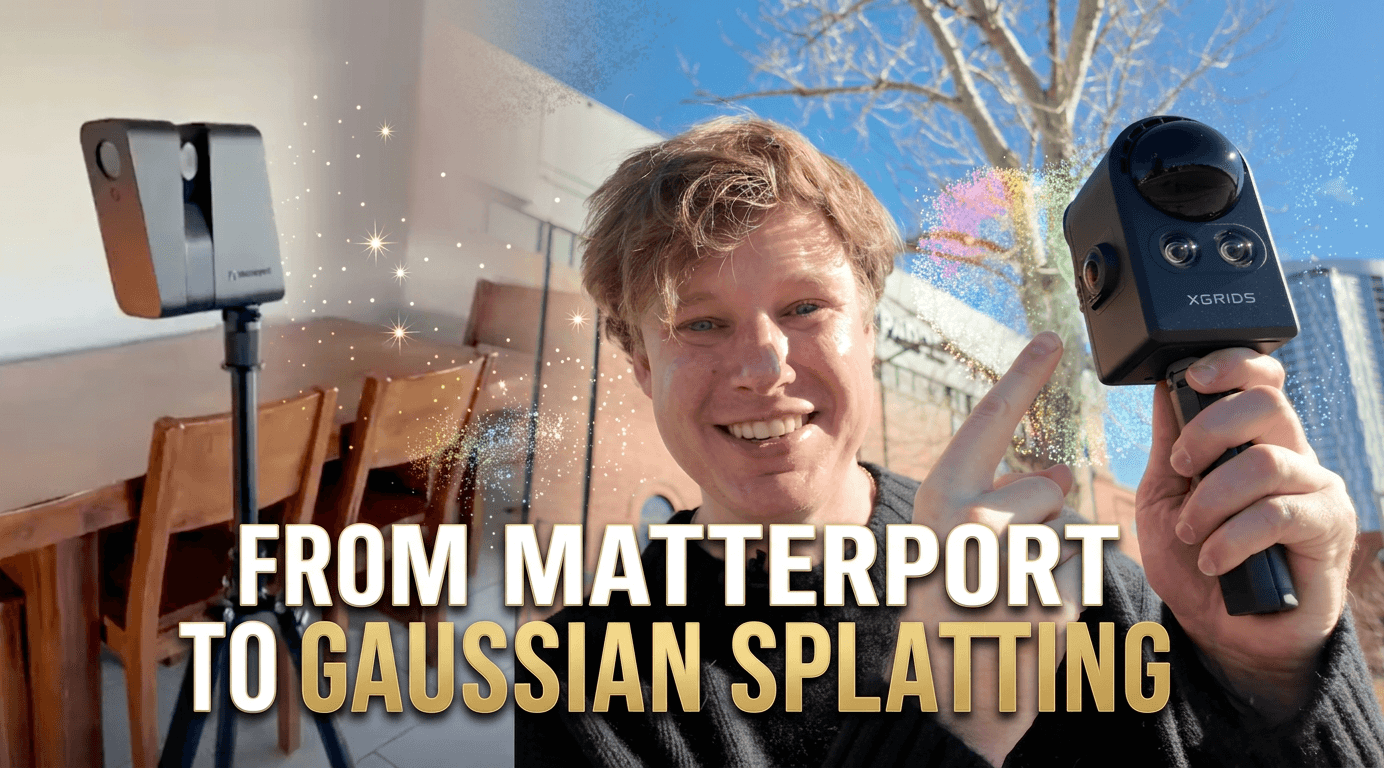
Terrestrial laser scanning (TLS) is slow. Setting up a tripod, scanning, moving, and registering targets takes hours — sometimes days — for large commercial spaces. Gaussian Splatting hardware, like the PortalCam, allows your team to capture space at a normal walking pace.
Stocker demonstrated an existing conditions capture of a full commercial space that took roughly 25 minutes — including the time to tie into survey control. Compared to traditional 360° cameras or manually dumping photos into a folder, the result is a complete, navigable 3D recreation of the entire site.
"Doing a quick capture through the space... I think this was maybe 25 minutes. In that short time, we have this fantastic-looking splat of the entire space... We have every nook and cranny of this space captured."
— Ben Stocker, Senior Construction Technologist, Skender
6. You Need to Empower Your Entire Team (Not Just the VDC Guys)
VDC specialists are highly trained and in high demand. They should not be spending their days walking job sites just to take progress photos. Gaussian Splatting hardware is so intuitive that anyone on site can do it.
At Skender, Stocker initially brought the technology in and did many of the scans himself. But he quickly trained project engineers and project coordinators to handle captures on their own — in a very short session.
"This doesn't have to be done by a technical, savvy VDC team. All of these progress captures... were all captured by our project engineers [and] project coordinators. In a very short session, I can show them how to use these scanners... and the processing is as easy as clicking a couple buttons."
— Ben Stocker, Senior Construction Technologist, Skender
When your entire field team can capture job sites independently, your VDC specialists are freed up for higher-value work — and your documentation coverage goes from sporadic to comprehensive.
The Verdict: Gaussian Splatting is the Future of AEC Delivery
If you are still relying on isolated 360° photos that lack 3D navigation, or sending heavy point clouds to clients who do not understand them, you are falling behind. Gaussian Splats give your stakeholders the photorealism they want, with the 3D spatial data your engineers need.
| Traditional Reality Capture | Gaussian Splatting with Splat Labs |
|---|---|
| Point clouds require specialized software | Photorealistic 3D opens in any browser |
| 360° photos lack spatial context | Full 6DOF navigation — go anywhere |
| Site walks required for every bidder | Share a link — bidders explore remotely |
| Hours/days for terrestrial laser scanning | 25 minutes for a full building capture |
| VDC specialists do all captures | Any team member can scan a site |
| Flat photo archives | 4D timelines with temporal scrubbing |
Ready to Deploy This on Your Next Project?
Splat Labs is the complete ecosystem for professional Gaussian Splatting. We provide both the enterprise-grade hardware to capture reality, and the cloud platform to host, measure, and share it.
Whether you need the immersive 360° spatial capture of the PortalCam or the survey-grade capabilities of the Lixel L2 Pro, we have the hardware your site demands.
EXCLUSIVE SPLAT LABS OFFER: When you purchase a PortalCam or Lixel L2 Pro directly through Splat Labs, you receive the full hardware package, the desktop processing software, PLUS a free 1-year Splat Labs Starter Plan (a $144 value). This free cloud hosting bonus is only available when purchasing through Splat Labs or our qualified resellers.
This article is based on the 3DGS Webinar: From Visualization to Application hosted by Xgrids on LinkedIn, featuring Ben Stocker of Skender. Want to see how Splat Labs connects to your existing tools? Read Construction Progress Monitoring with Gaussian Splats for a hands-on breakdown. Questions? Contact us directly.