
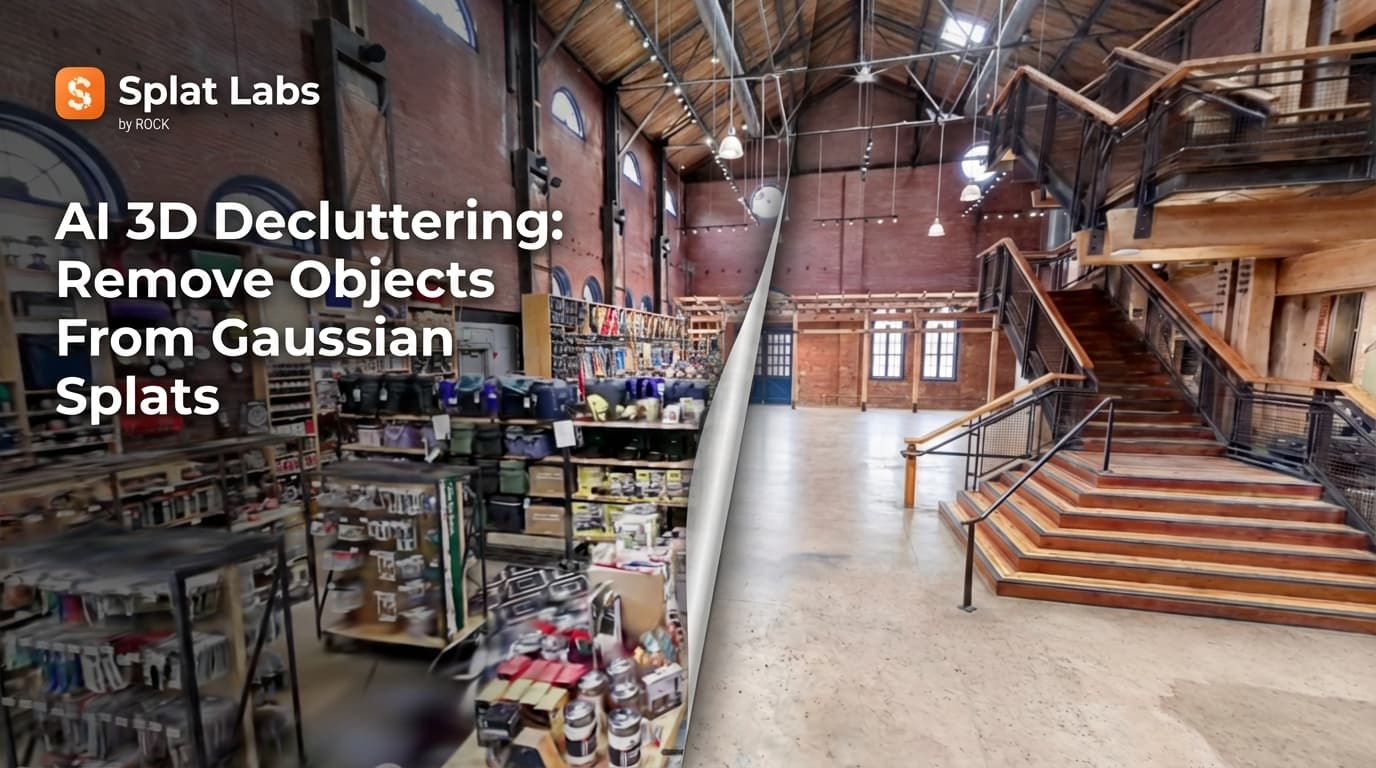
We walked into the REI Denver Flagship store on a Tuesday afternoon. Ninety thousand square feet of active retail — clothing racks from floor to ceiling, hundreds of bicycles hanging overhead, shelving units packed with camping gear, and somewhere north of 200 customers wandering the aisles.
Then we told the AI to make it all disappear.
Not the building. Not the walls or the floors or the 45-foot climbing wall in the center of the store. Just... everything else. The inventory. The shelving. The racks. The clutter. All of it.
One text prompt: "Remove all shelving, backpacks, and clothing racks."
And it did.
See It for Yourself
The REI Denver Flagship — 90,000 sq ft of active retail — captured as a 3D Gaussian Splat, then transformed with a single AI prompt.
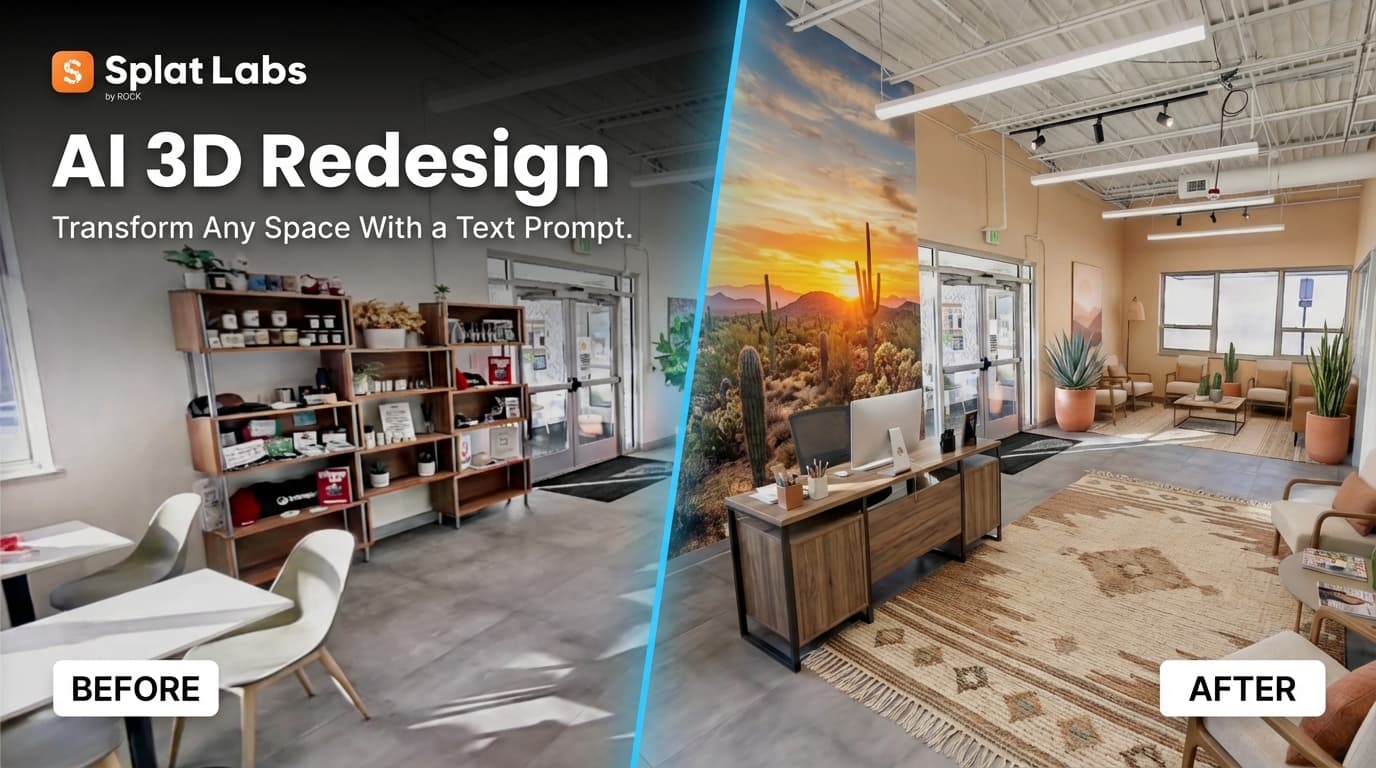
What you are looking at starts as a real 3D Gaussian Splat of a real building. From any viewpoint inside that model, Splat Labs generates a photorealistic AI image of the space redesigned to your spec. One scan, any viewpoint, any prompt.
Watch the Full Walkthrough
The full REI Denver Flagship walkthrough — from 3D capture to AI-generated removal — on YouTube.
Explore the Dataset
Navigate the REI Denver Flagship yourself. Click and drag to move through the space:
The Problem We Were Trying to Solve
Here is the situation that every commercial real estate broker deals with: you have a space. It is occupied. The current tenant's stuff is everywhere. And you need to show a prospective tenant what that space looks like empty — so they can picture their own business in it.
The traditional options are expensive and slow. You can hire a demo crew to tear everything out ($10,000 to $100,000+ depending on the space). You can wait for the current tenant to leave, which might take months. Or you can send your prospect to tour the space as-is and hope they have a good enough imagination to look past the camping gear and see their future restaurant.
Most of them cannot. Most people walk in, see someone else's business, and walk out. The space sits vacant for another six months.
This is the "imagination gap" — and it costs commercial landlords millions of dollars a year in lost leasing velocity.
How We Did It
The workflow is almost absurdly simple. We captured the REI store with a PortalCam — just walked through the space while the device recorded. Uploaded the Gaussian Splat to Splat Labs Cloud — at this point, anyone with a link can walk through the full 3D model in their browser. Then we opened AI Scene Redesign, navigated to a viewpoint inside the model, typed what we wanted removed, and hit submit.
The AI generated a photorealistic image of that exact viewpoint with the clutter gone — the brick, the concrete, the support columns, the 45-foot climbing wall all revealed as if the store had been emptied overnight.
A few things that stood out:
- It took minutes, not weeks. A physical tear-out of a space this size would cost six figures and take days of labor. This took a text prompt and a few minutes of cloud processing.
- The proportions are accurate. Because the AI image is generated from real spatial data, the architecture, lighting, and scale are true to the actual building — not approximated from a floor plan or a single photo.
- Anyone can view the result. No special software, no app download, no VR headset. Share the original 3D model as a link and share the AI-generated images alongside it.
Why This Is Not the Same as Virtual Staging
You have probably seen 2D virtual staging services — BoxBrownie, Styldod, that sort of thing. Those are photo editors. You send them a JPEG of a room, they digitally remove the furniture and replace it with different furniture, and you get back a different JPEG. One fixed angle. One flat image.
What makes this different is the foundation. Because we start from a real 3D Gaussian Splat of the space, you can navigate to any viewpoint inside the model and generate an AI image from that exact perspective. Want to see the corner near the entrance? The back wall? The mezzanine looking down? Navigate there, run the prompt. Every image is generated from real spatial data, so the proportions and architecture stay accurate — you are not guessing what the space looks like from a different angle, you know.
The original 3D model stays live and walkable the whole time. Your prospects can explore the actual space themselves, and your AI images show them what it could look like.
What You Do With the Project
Once you have the 3D scan and your AI-generated images in Splat Labs, everything lives as a live project on the platform.
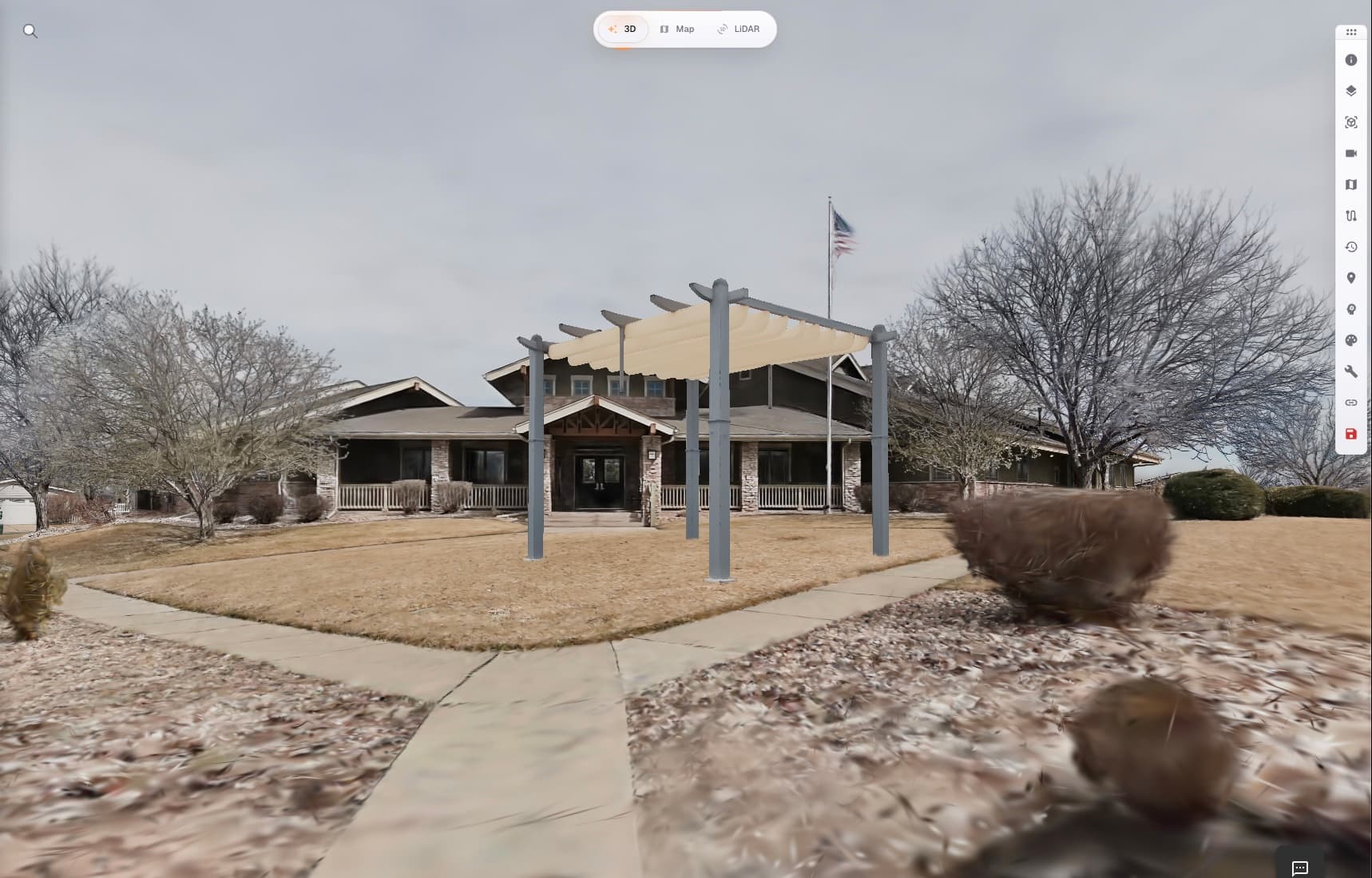
You can share the 3D model as a link — your prospect walks through the actual space in their browser, no account needed. You can embed it on your website — drop an iframe on Zillow, your brokerage site, or a property listing page (here is the embed guide). You can generate an AI floor plan from the 3D scan with one click.
And you can keep generating AI images from the same scan — different viewpoints, different design concepts. Show the space as a modern restaurant, a coworking space, a showroom. Every concept runs from the same capture. AI Redesign lets you go beyond removal and apply entirely new interior designs too.
For enterprise teams, Splat Labs supports multi-user workspaces with role-based permissions, automatic team sharing, and white-label branding — so your clients see your brand, not ours.
Getting Started
If you want to try this yourself, the entry point is simple. Create a free Splat Labs account — the free tier includes two projects, which is enough to upload a Gaussian Splat and experiment with AI features.
For capture hardware, the PortalCam is what we used for the REI scan. It is a handheld spatial camera with dual-fisheye lenses and LiDAR — you just walk through a space and it captures everything. The Standard package starts at $4,999 and includes a free year of Splat Labs Starter ($144 value). But Splat Labs is hardware agnostic — you can upload Gaussian Splats from Polycam, Luma AI, DJI drones, or any device that outputs PLY/SPLAT/KSPLAT files.
AI Scene Redesign features (Remove, Redesign, and Add) are available on all plans with pay-as-you-go pricing.
What Is Coming Next
We are currently building Prompt-to-True-3D — the ability to generate entirely new volumetric 3D objects and meshes directly inside a Gaussian Splat from a text prompt. Not just visual modifications, but actual geometry you can export, measure, and plug into CAD or BIM workflows.
If you want early access, reach out to our team.